Date:
Frequency:
Concevoir son stand
Are you preparing for a trade show and considering creating a custom-made booth? Surface area, layout, design, budget, materials, deadlines, logistics... Behind a few square meters of exhibition space lies a real ephemeral architectural project.
And because a beautiful booth is not enough, it still needs to be designed to attract, welcome, present, interact, and bring your brand to life.
After more than 30 years and 12,000 projects, we are starting to have a few ideas on the matter. Discover ours below.
What is a custom-made booth?
Unlike a standardized booth based mainly on an assembly of predefined modules, a custom-made booth is designed specifically for ONE brand, ONE show, and SPECIFIC objectives.
Volumes, circulation, materials, furniture, lighting, signage, reception or demonstration areas: its design starts from a blank page (or almost).
The booth thus becomes a physical translation of the brand identity.
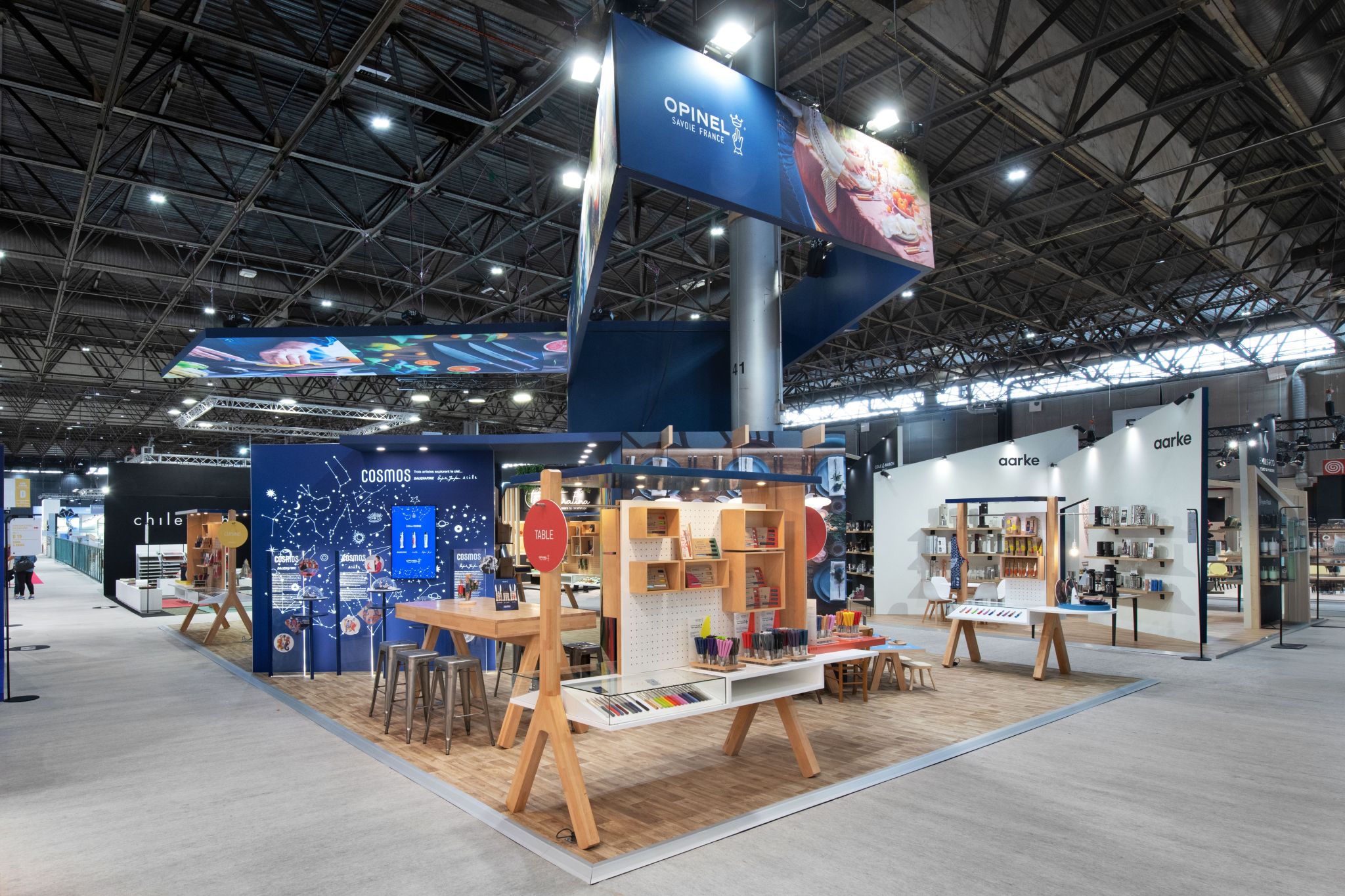
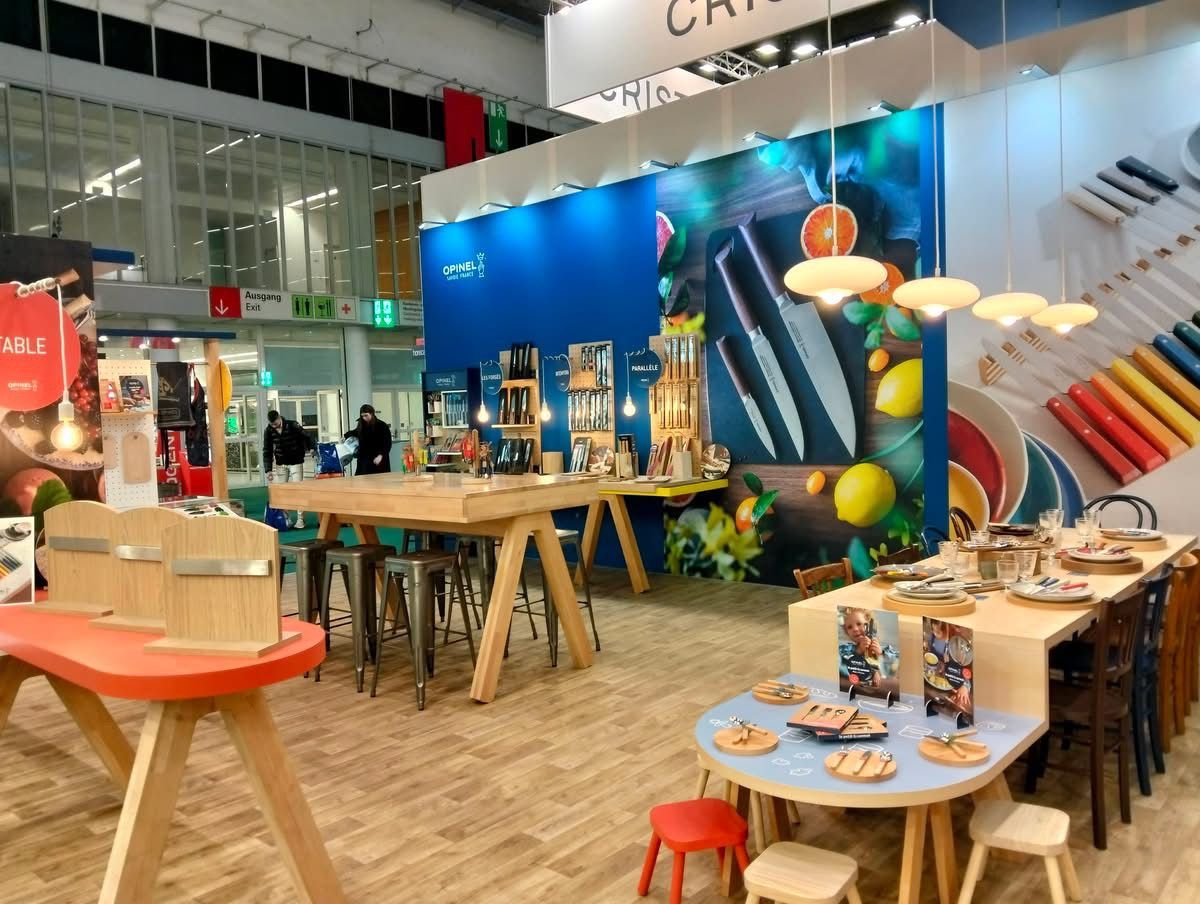
At Expace, this can take the form of a warm and open 84 m² booth for Opinel, a 1,000 m² space for Arquus, or solutions designed for the worlds of healthcare, industry, gastronomy, luxury, or tech.
In short: custom-made truly lives up to its name.
Why choose a custom-made booth for a trade show?
To make your brand immediately identifiable
At a trade show, every brand has just a few seconds to capture visitors' attention.
The design of a booth must allow them to quickly understand who you are, what you offer, and why they should stop.
It is therefore not about piling up flashing visual effects everywhere. Colors, volumes, materials, lighting, and signage must build a coherent language with your identity.
For Opinel at Maison&Objet, Expace relies, for example, on the brand's historical codes (Opinel blue and oak) in a nomadic boutique concept open on three sides. The booth thus evolves from one edition to another without losing its identity.
To design the space around your objectives
A booth designed to present a technological innovation is not organized the same way as a space designed to host distributors or showcase food products.
Before drawing, you must therefore know what the booth needs to allow you to do:
welcome and guide visitors;
showcase products;
conduct demonstrations;
organize confidential meetings;
generate leads;
receive clients or partners;
create a brand experience;
speak or broadcast content.
The design comes next. Not the other way around.
How to design a custom-made booth?
1. Start with a good brief
Trade show, location, surface area, number of open sides, objectives, targets, products to present, required spaces, technical constraints, graphic identity, budget... Take the time to write a complete brief.
It takes time. But the more precise the brief, the more relevant the exhibition designer's response will be.
But don't panic if everything is not yet defined. The role of a good booth builder is also to challenge your specifications and recommend the most suitable solutions.
2. Think about flows before walls
A successful booth must make sense naturally.
Where do people enter? What do they see first? Where does a demonstration take place? Should the discussion areas be open or confidential? Where should documents, personal items, or products be stored without exposing them to visitors?
Circulation is an integral part of the design.
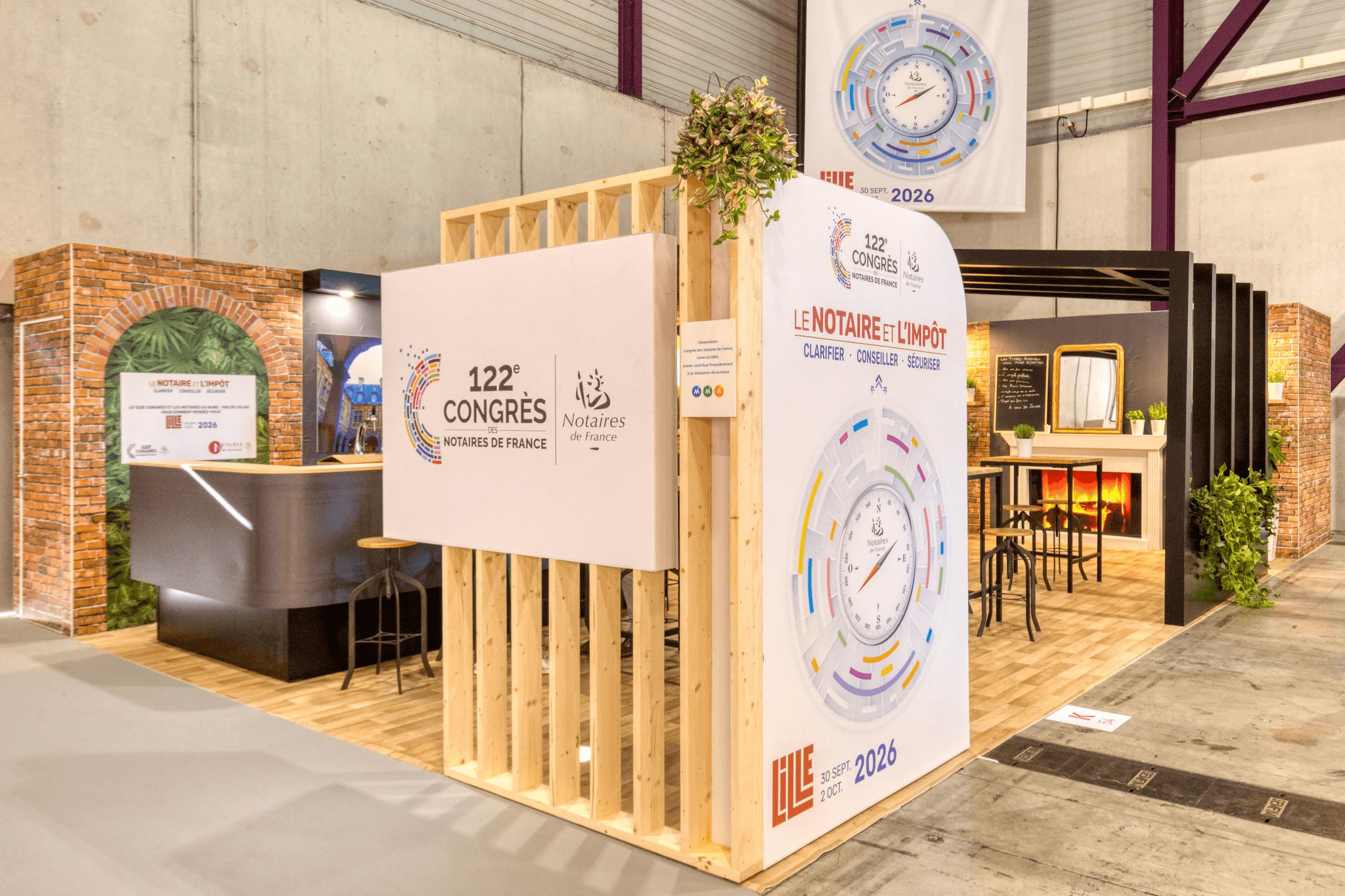
On the Association des Notaires booth at the Congrès des Notaires, the challenge was notably to create a space with a strong identity while promoting exchanges with professionals in the sector. Design then becomes a tool at the service of human connection.
3. Build an identity in space
The booth must extend the brand's universe without limiting itself to reproducing its graphic charter in large format.
The work focuses in particular on:
volumes and perspectives;
materials and textures;
colors;
lighting;
custom furniture;
signage;
digital setups;
product showcasing.
For premium brands, this coherence is particularly important: perceived quality is sometimes decided in a few millimeters of finishing.
What surface area should you choose for your booth?
There is no universal ideal surface area.
A small, perfectly organized booth can be much more effective than a large, poorly utilized space.
The right surface area depends mainly on the number of expected visitors, the functions to be integrated, and the format of your presence.
A project may require:
a reception area;
several discussion areas;
a storage room;
a demonstration area;
a bar or hospitality area;
meeting rooms;
a stage;
or even a mezzanine.
At a large scale, the challenges change again. For Arquus at Eurosatory, we notably worked on a 1,000 m² setup and adapted different solutions according to the brand's international events.
The question is therefore not just: “How many square meters do we have?” But rather: “What do we want to do with every square meter?”
What materials should be used for a custom booth?
Wood, metal, fabric, glass, flooring, paint, plants, screens... the choice of materials depends as much on the creative concept as on technical, budget, and environmental constraints.
At Expace, recommendations take into account:
the desired aesthetic result;
the required durability;
weight and transport;
ease of assembly and dismantling;
reuse possibilities;
the constraints of the exhibition venue.
Eco-design is very important to us and constantly pushes us to think of the booth beyond a single edition.
We always ask ourselves these questions: what can we keep, transform, store, or reuse?
Custom-made booth or modular booth: which to choose?
Both meet different needs.
The custom-made booth offers you maximum creative and architectural freedom. It is particularly suitable when a brand wants to create a strong experience, work with specific volumes, or meet more complex specifications.
The modular booth, on the other hand, prioritizes scalability and reuse. It can be reconfigured according to different surface areas and different events.
Good news: you don't have to choose a side!
A project can very well combine reusable structures and custom-made elements in order to find the right balance between identity, flexibility, budget, and sustainability.
This is notably the logic adopted with Opinel: the permanent concept evolves according to the available surface areas and the editions of Maison&Objet, while its structural codes are preserved. We also took care of storing the elements between assemblies.
How much does a custom-made booth cost?
This is generally the question that comes right after "Do you have an idea?". And our answer will always be "It really depends on the project."
The price of a custom-made booth varies in particular according to:
its surface area and height;
the complexity of the design;
the materials and finishes;
specific furniture;
audiovisual and digital equipment;
the trade show constraints;
transport;
assembly and dismantling;
the destination;
the potential for reuse.
Comparing two booths solely on their price per square meter can therefore be misleading.
The right reasoning is rather to define a budget and determine where to invest to maximize the impact of the project.
How long does it take to create a booth?
The earlier we start, the better.
The design of a custom-made booth includes several steps:
Brief → creative concept → 3D plans → approval → technical plans → manufacturing → logistical preparation → assembly → event → dismantling.
It is also necessary to integrate the organizer's approval times, the technical constraints of the show, printing, material orders and, for some projects, international logistics.
Anticipating allows, above all, to maintain more creative freedom and prevent calendar constraints from starting to design the booth for you.
What does an exhibition stand builder actually do?
An exhibition designer does not just draw and then assemble a set.
At Expace, support can cover the entire project:
analysis of the specifications;
recommendations on layout and materials;
conception and design;
3D plans and technical plans;
relationship with trade show organizers;
site scouting;
manufacturing of custom structures and furniture;
carpentry and metalwork;
cladding and digital printing;
logistics;
installation;
assembly and dismantling;
support and maintenance;
storage between two events.
The goal is simple: to let you manage your show while we manage your booth.
And for a trade show abroad?
Designing a booth in Paris and installing it on the other side of the world obviously does not raise the same questions.
Local regulations, transport, manufacturing, team coordination, site access, assembly times: an international project requires specific organization.
Expace supports projects in France as well as internationally thanks to our locations in Lyon, Paris, Hong Kong, and Montreal.
For Arquus, for example, the setups were deployed at various events from Jakarta to Kuwait, then in Paris.
One single brand, multiple destinations, the same requirement for consistency.
Can a custom-made booth be reused?
Yes, yes, and yes again! The question is worth asking right from its design phase.
Reusing does not necessarily mean reproducing exactly the same booth at each show. Some elements can be kept while others evolve:
structures;
furniture;
signage;
decorative elements;
equipment;
graphic supports.
This approach allows to amortize certain investments, reduce manufacturing needs, and maintain a recognizable identity from one event to another.
Storage then becomes an integral part of the event strategy.
The 7 questions to ask yourself before briefing your exhibition designer
Before starting, answer these first:
Which trade show are we participating in and why?
Who do we want to meet?
What do we want visitors to understand immediately?
What should they be able to do at our booth?
What surface area and constraints do we have?
What budget do we want to dedicate to the project?
Will the booth need to be reused?
If you have all 7 answers, congratulations, we are ready for your brief!
If you only have 3 or 4, we can already start by discussing it.
A custom-made booth is, above all, a space that has a job to do!
Catching the eye is only the beginning…
A good booth must then allow to meet, present, exchange, convince, and leave a lasting impression in the visitor's mind. It is this combination of brand identity, usage, design, and technical mastery that transforms an exhibition space into a real communication tool.
At Expace, we have been designing and building custom booths for over 30 years, in France and internationally.
So, if you have a project in mind, tell us about your next show. We will give it space!

William Kothe
EXPACE trade show expert

LYON
ZAC Caillou
10 Jules Verne Street
69630 Chaponost
France
Paris
229 Avenue de Paris
78820 Juziers
France
ASIA
Unit 1213, 12F
Wing On Plaza
62 Mody Road
Tsim Sha Tsui, Kowloon
Hong Kong
America
160 Saint Viateur St. East
6th Floor #610
Montreal
Quebec H2T 1A8, Canada
our partners